Serbia '14: Mount Cer - The Achilles Heel

Background
Mount Cer, Serbia, 16 August 1914:
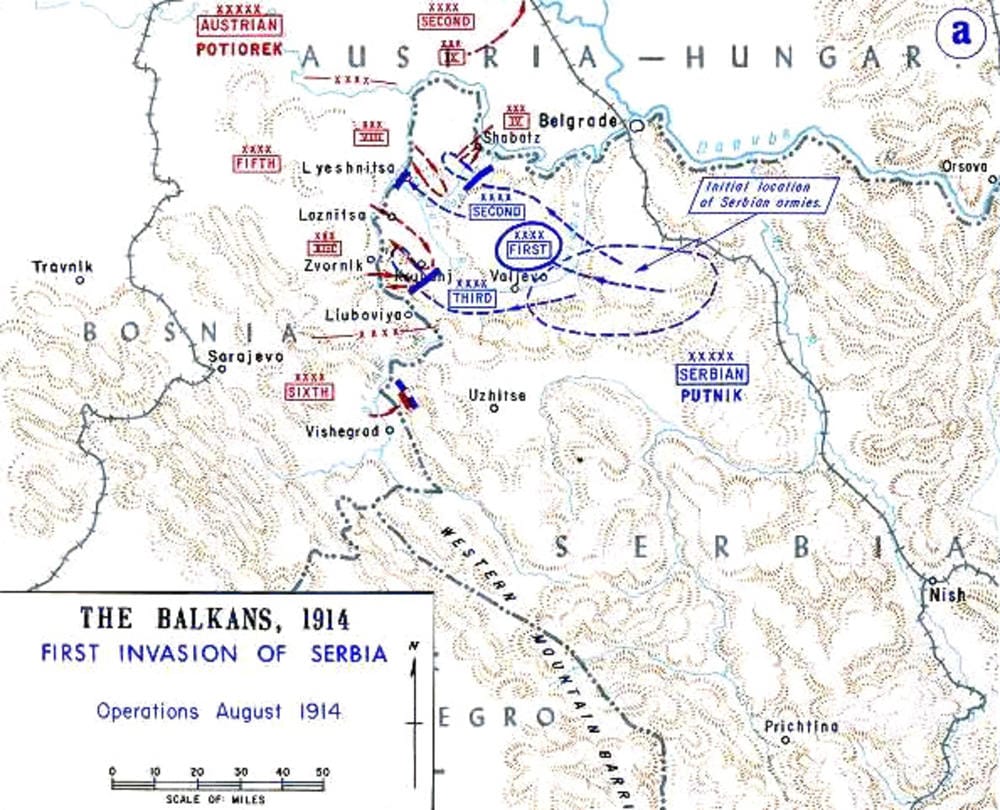
During the 1st Austro-Hungarian invasion of Serbia, the Serbians stressed a plan that concentrated on Mount Cer, the dominating terrain feature in the Mačva Peninsula and also the central point between the Austro-Hungarian 2. and 5. Armee. On the other hand, the Austro-Hungarians stressed a plan of attack that concentrated on both wings, with the 2. Armee applying pressure from Šabac in the north, and the 42. Honvéd Inf-Div. and two independent brigades swinging around to the south at Krupanj. This attack threatened a double envelopment of the Serbian 3rd Army, but 2. Armee's pressure never really materialized until it was too late, due to a lack in desire to commit the full force to the campaign since the army was scheduled to be withdrawn for Galicia.
Trouble came on the night of the 15/16th, when the Austro-Hungarian 21. Landwehr Inf-Div blundered into the Serbian Combined Division on and to the north of Mount Cer. The Combined Division had just finished executing a series of forced marches and was in a very fatigued state, but it immediately went into the attack as per the Serbian plan. It just so happened that the 21. Landwehr Inf Div. was greatly disorganized and disrupted from moving through the night to keep up with the 9. Infanterie Div. to their south, and for greater mobility was split into two parts that were far apart from each other. The short, sharp collision threw the right wing of the Austro-Hungarian division into an even more disrupted state and caused the left wing to pull back, exposing a gap between both Austro-Hungarian armies. The Serbians gradually exploited this gap and continuously threatened Mount Cer to the point that it would become an Achilles heel, since the Austro-Hungarian 9. Infanterie Div. was forced to protect its flank thereby weakening its eastward advance.
Brief
0600, 16 August 1914
Mission
VIII. Korps has successfully seized the peak of Mount Cer, but subordinate units, (mainly 21. Landwehr Inf Div) have become scattered and isolated, and are facing a meeting engagement by the Serbian Army in the vicinity of Mount Cer, Milina, Pt. 426 and Jarebice. VIII. Korps has already seized the objective it set out to achieve, but will rapidly need to reconstitute itself and defend the sector in the face of the oncoming Serbian advance. End state: 5. Armee continues to hold Mount Cer and Milina, and Pt. 426, Jarebice and Filipovici-Draginac are secured in order to consolidate a defensive line.
Enemy
Serbian 3. Army is confirmed in the area and has been continuously engaged since the start of operations, and is therefore assessed to be fatigued. Confirmed presence of the Combined Division and Sumadija I Division indicates elements of 2. Army are also present. 2. Army has just completed a forced march into the sector and is likewise assessed as fatigued. Total Serbian strength is estimated at two to four divisions, alongside various irregulars operating alongside 3. Army.
Most likely, 3. Army will attempt to isolate and destroy the already separated elements of 21. Landwehr Inf Div., then assault Mount Cer. 2. Army will likely establish a defense line between Tekeris, Jarebice and Filipovici-Draginac, while supporting 3. Army's effort against Mount Cer.
Most dangerous would be a coordinated attack by both armies against Austro-Hungarian units before a firm defensive line can be established.
Terrain and Weather
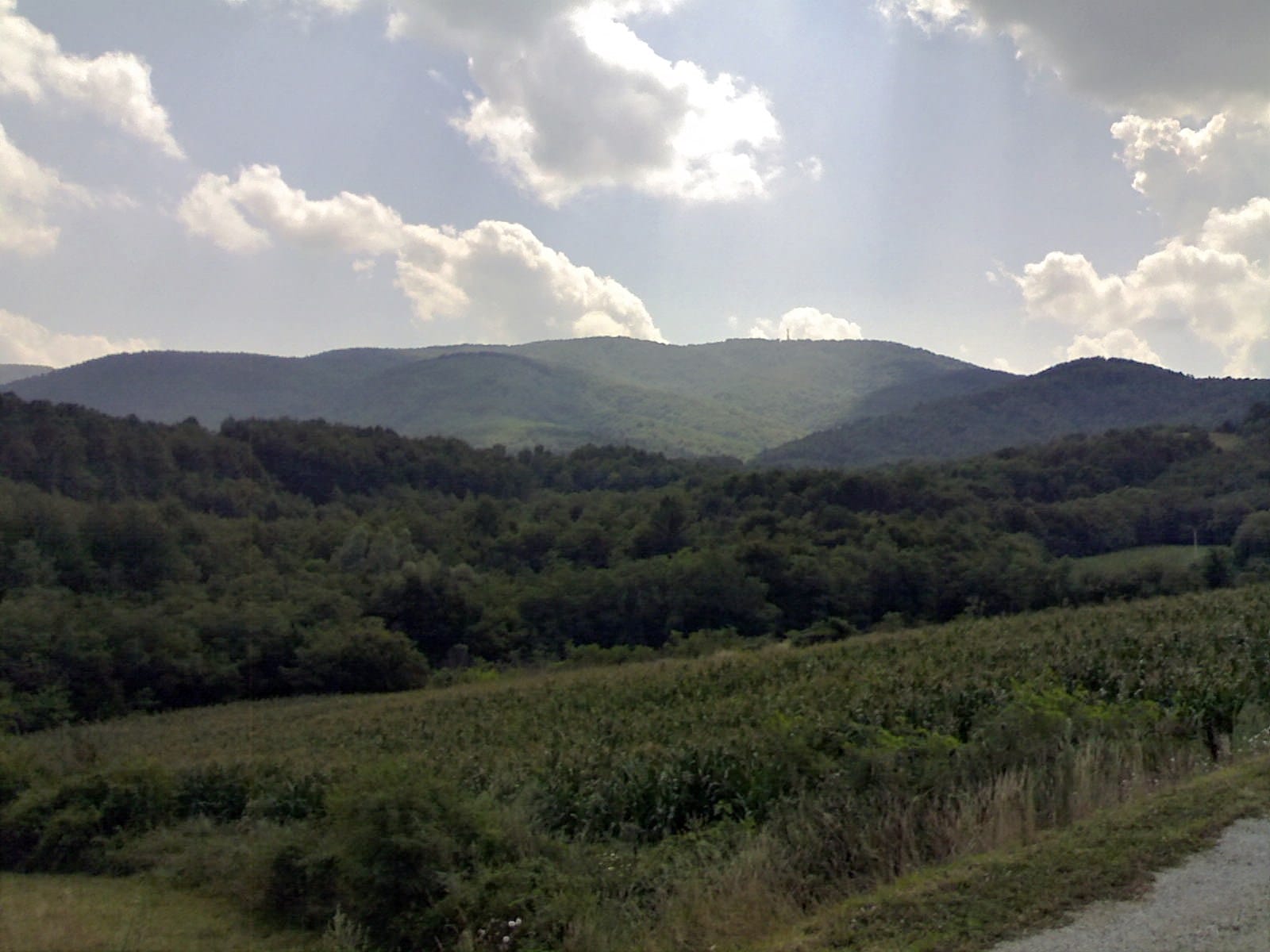
The area of operations is dominated by the steep, wooded terrain of Mount Cer. Small streams are common, with farm fields and villages on the lower ground.
Good roads are scarce. A single secondary road runs north-south from Slatina to Zavlaka behind the Serbian positions. Another secondary road runs north-south Petlovaca to Loznica, on the eastern side of the Drina river, behind the Austro-Hungarian positions. Aside from these roads, movement depends on small, rugged trails which will complicate supply for both sides.
Weather is currently Normal, with 3-4km visibility during daylight hours. Predictions for the next 24 hours is 100% chance of Normal conditions, with visibility ranging between 3km and 4km. Sunrise is at 0600 and sunset at 1800.
The amount of obstacles in the operational area is deemed to be low, aside from the generally rugged terrain. The enemy currently occupies a position overlooking the proposed Milina-Pt. 426 line to its west. This position is separated by a small stream.
The enemy approach to Mount Cer summit is likely to be from the south-east. The old ruins of Trojanov Fortress is present in this area which will provide the enemy with some protection on their advance. The enemy is likely to approach Pt. 426 along a spur of sorts running south-east to the position, as this approach also offers good overwatch on the objective at Jarebice.
The most suitable approach to Filipovici-Draginac for friendly forces would be the secondary road running west-east along the Jadar river. This will facilitate rapid movement. A number of stream crossings will provide ideal defensive sectors for the enemy, however.
Key positions in the area are Mount Cer summit and Pt. 426, as both provide good observation and fields of fire over the surrounding areas, and would be an ideal position in which to situate field guns.
The slopes of Mount Cer, being heavily wooded, will provide good cover and concealment to defending units.
Troops Available
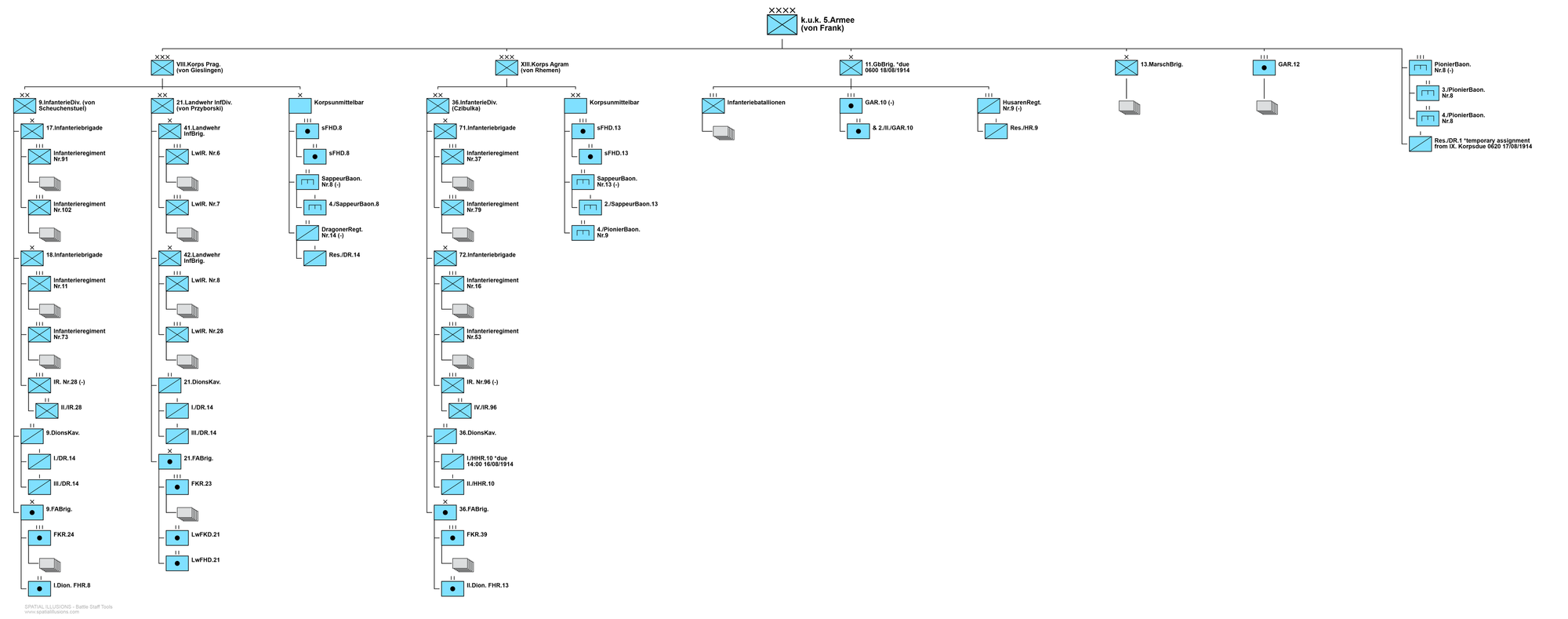
Friendly forces are as follows:
Time
76 hours have been allocated to stabilize and consolidate friendly presence in the area. Operation set to conclude at 1000, 19 August.
Civil Considerations
Civilian presence is expected to be negligible.
Execution/Tasks
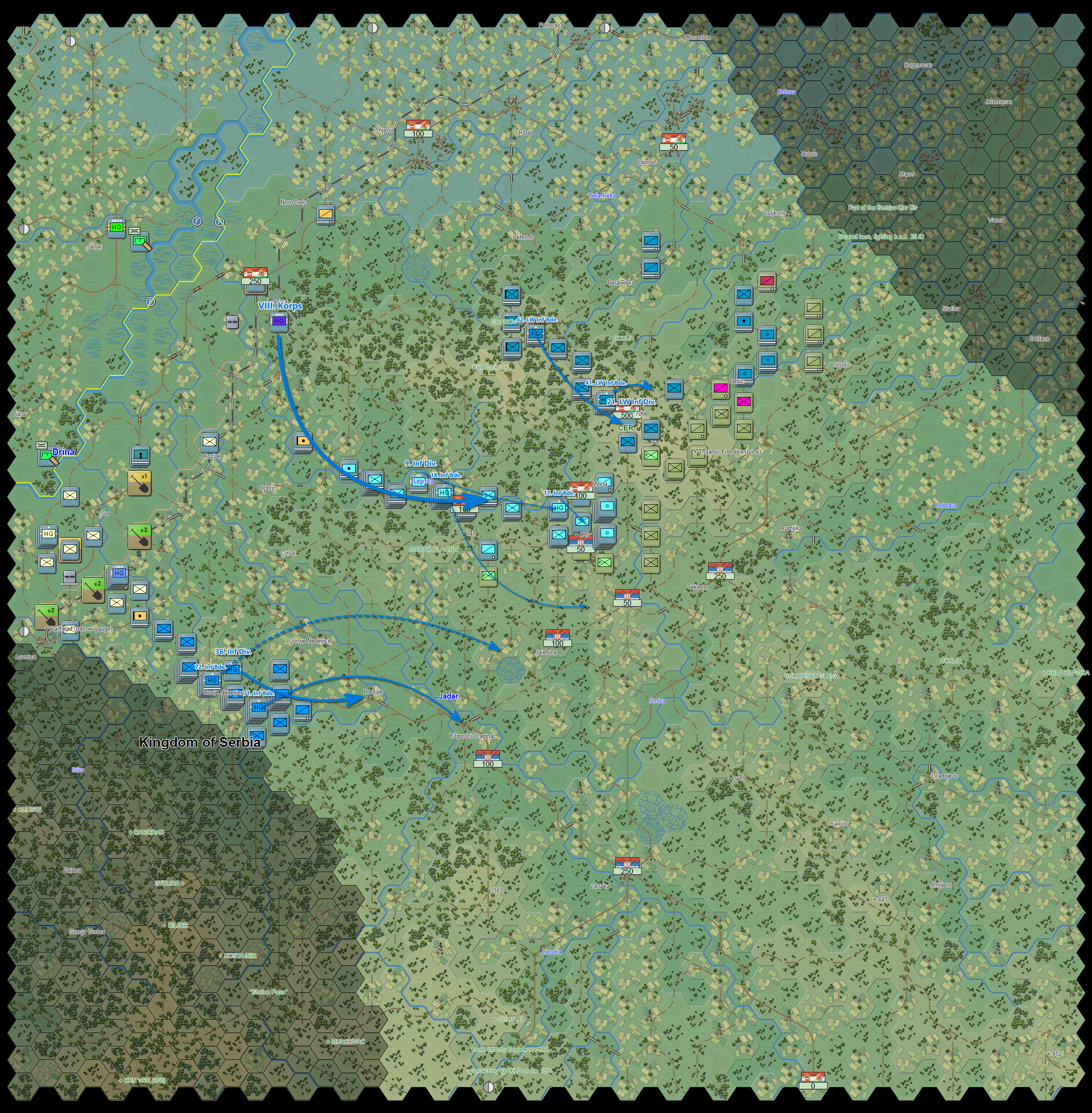
21. LW Inf Div. to withdraw both brigades to vicinity of Mount Cer summit and consolidate. Note that this formation will be brittle due to a moderate state of disruption and casualties sustained in prior days. 41. LW Inf Bde. to withdraw from its current forward position and establish a defense on northern slope of Mount Cer. 42. LW Inf Bde. to fortify Mount Cer summit with support from divisional artillery. This position will enable the division to influence 9. Inf Div's defensive sector and vice versa.
9. Inf Div. to assault and consolidate Pt. 426, and occupy surrounding area. 17. Inf Bde. to establish defensive line between Milina and Pt. 426, with divisional artillery positioned at Pt. 426. 18. Inf Bde. to wheel, anchored on 17. Inf Bde's right flank, toward Jarebice, clearing as they go before joining the right flank of the defensive line established by 17. Inf Bde.
36. Inf Div. to advance on Filipovici-Draginac, consolidate and establish a defensive position. 71. Inf Bde. to lead the advance. 72. Inf Bde. is to remain as a reserve and be utilized as opportunities are presented. Alternatively, 72. Inf Bde. could relocate north to support 9. Inf Div.
11. Gb Bde. to advance on Zavlaka upon arrival on 18 August and threaten the Serbian southern sector.
Battle
Actions of 16 August 1914
21. LW Inf Div. struggled to consolidate its position on Mount Cer Summit, with 42. LW Inf Bde. slowly withdrawing from their forward positions along with the divisional artillery under heavy Serbian fire up the slope of the mountain. 41. LW Inf Bde. continued their slow march up the mountain along the narrow tracks to the west. The division interspersed their withdrawl with defensive fire, weakening Serbian units that approached too closely. By around 1400, most of the division was in position in forward defensive positions, with 41. LW Inf Bde. protecting the northern approaches and 42. LW Inf Bde. on the summit itself. The division would continue to take heavy rifle and artillery fire throughout the day. Concurrently, the division's cavalry element, DR. 14 spent the afternoon screening the withdrawing brigade and getting into skirmishes with the Serbian Cavalry Division, lightly contesting the village of Lipolist before being forced to withdraw.
17. Inf Bde. under 9. Inf Div. spent the morning assaulting and securing Pt. 426 in order to establish a defensive line running from Milina, 2km to the north, and the rest of the day conducting defensive fire against advancing units from the Morava I Division, while 18. Inf Bde. which had started the engagement in a column several kilometers behind them, executed a wheeling maneuver, sweeping up scattered Serbian units between the Iverak Planina and Jarebice in order to strengthen the division's right flank.
36. Inf Div. got released around 1000 on the morning of the 16th, and would make a push towards Brezjak, with 71. Inf Bde. in lead and 72. Inf Bde. in reserve. The move on Brezjak revealed only a small Serbian contingent, but confirmed the presence of the Drina I Division in the area.
The situation at 0000 17 August 1914
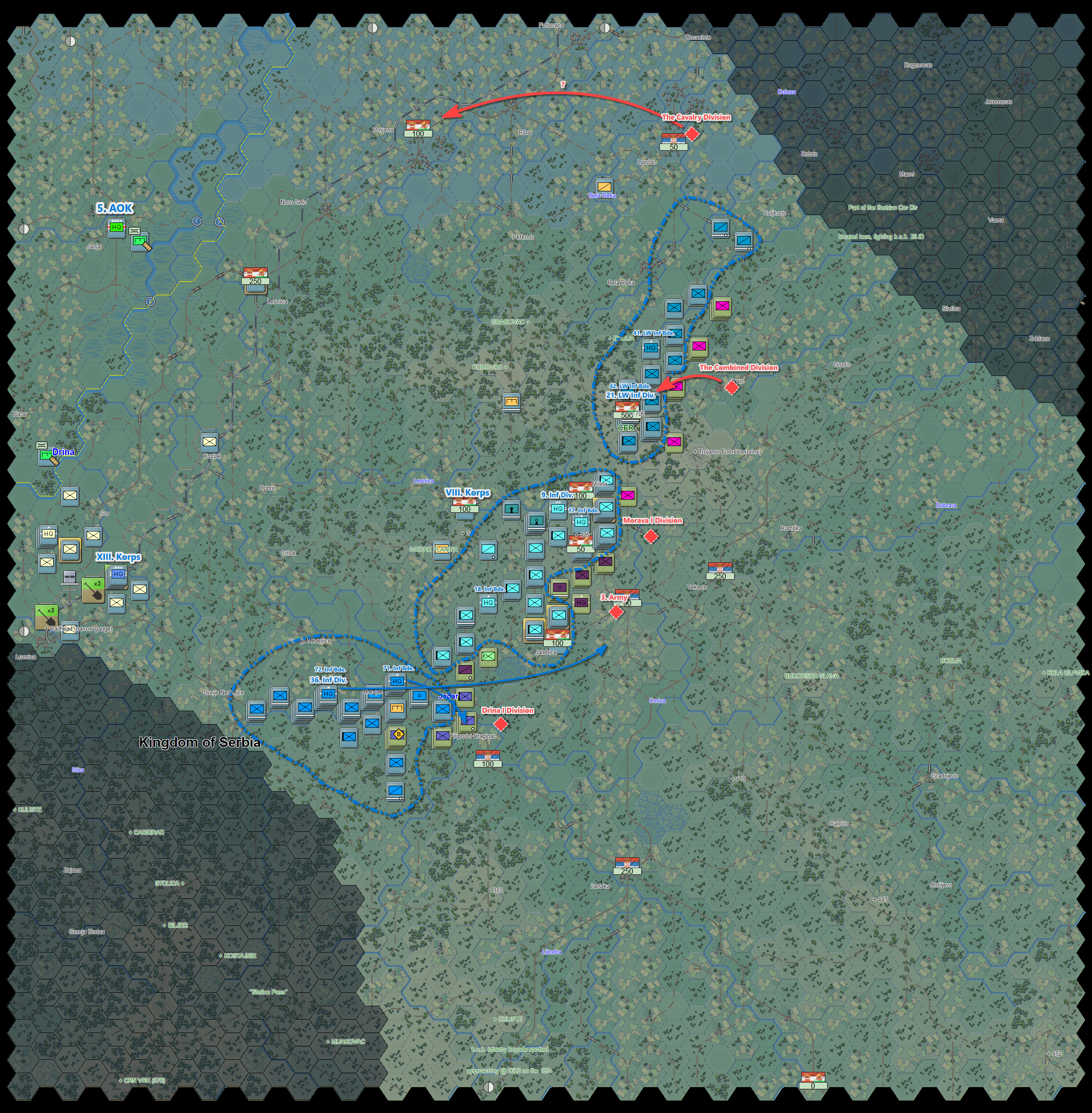
The Cavalry Division has successfully pushed north to Lipolist and seized the village, bypassing 21. LW Inf Div. 5. AOK scout elements are tracking enemy movements, along with scout elements from 21. LW Inf Div, although they will be unable to provide much of a deterrence to these units. Northern flank is highly vulnerable to exploitation. 21. LW Inf Div. may be in a position to cut these units off from communication as opposed to a direct engagement.
21. LW Inf Div. still holds Mount Cer Summit and a portion of the northern slope. 41. LW Inf Bde's withdrawal to the summit has been somewhat disorganized, with high casualties, breakdown in communications, and low ammunition supplies as the Combined Division has kept up offensive pressure, successfully conducting a number of assaults on positions on the slopes of the mountain. 21. LW Inf Div. is in a highly brittle state. Engineers are due to arrive later on 17 August to assist with construction of improved fighting positions. Field guns and howitzers from 21. LW Inf Div. have also reached the summit following a precarious withdrawal from the lower slopes, and will be in a position to start conducting supporting fire at dawn 17 August.
9. Inf Div. has been successful in holding the Milina-Pt. 426 defensive line. 17. Inf Bde. have conducted effective fires on Serbian 3. Army and Morava I Division units. Improved fighting positions have been established in a number of locations, with more due to be constructed on 17 August with assistance from army-level engineers. Corps and Army-level howitzers have also arrived in this sector and should be able to assist defensive operations during 17 August. Establishment of firing positions for artillery units will likely take most of the morning. The wheeling movement from 18. Inf Bde. has also been a success, clearing numerous lightly held Serbian positions along the way, before conducting an assault on Jarebice, securing it in the process. This also allowed for the fixing of Serbian 3. Army heavy weapons (MG and field guns). 18. Inf Bde. have taken casualties under sporadic fire but possession of Jarebice ensures security of 9. Inf Div's right flank. 18. Inf Bde. will need to quickly adopt a defensive position, establishing a line from Pt. 426 to Jarebice in light of the Morava I Division most likely conducting more concentrated offensive efforts on 17 and 18 August.
36. Inf Div. have been moderately successful in their advance on Filipovici-Draginac spearheaded by 71. Inf Bde, clearing Brezjak on the way, and isolating 2 battalions of infantry from Drina I Division. These battalions are in a position where they can possibly be reduced and destroyed through 17 August. Forward elements of 71. Inf Bde. have taken heavy fire from Filipovici-Draginac, sustaining significant casualties in the 2 forward battalions (I & III./IR. 37). 72. Inf Bde. is to be shifted from a reserve posture to supporting 9. Inf Div, bypassing the rest of 36. Inf Div's objectives, while 71. Inf Bde. continues its advance on Filipovici-Draginac.
Actions of 17 August 1914
21. LW Inf Div. sustained heavy fire from Serbian units around Mount Cer before coming under direct assault. A number of units broke and commenced unplanned withdrawals. The bulk of the division managed to remain in place as Serbian efforts intensified.
9. Inf Div's 17. Inf Bde. continued to hold the Milina-Pt. 426 line under increasing pressure from the Morava I Division, which formed up for assaults on numerous occasions, but being repelled each time. 18. Inf Bde. initially consolidated on Jarebice before advancing east toward the Crnica river and more open fields of fire.
36. Inf Div's 71. Inf Bde. spent the day clearing the area immediately beyond Brezjak, isolating 2 battalions of Serbs in the process, and reducing these units. 72. Inf Bde. would spend the majority of the time navigating down the Jadar River valley toward Jarebice, engaging in minor skirmishes with scattered units from the Serbian 3. Army.
The situation at 0000 18 August 1914
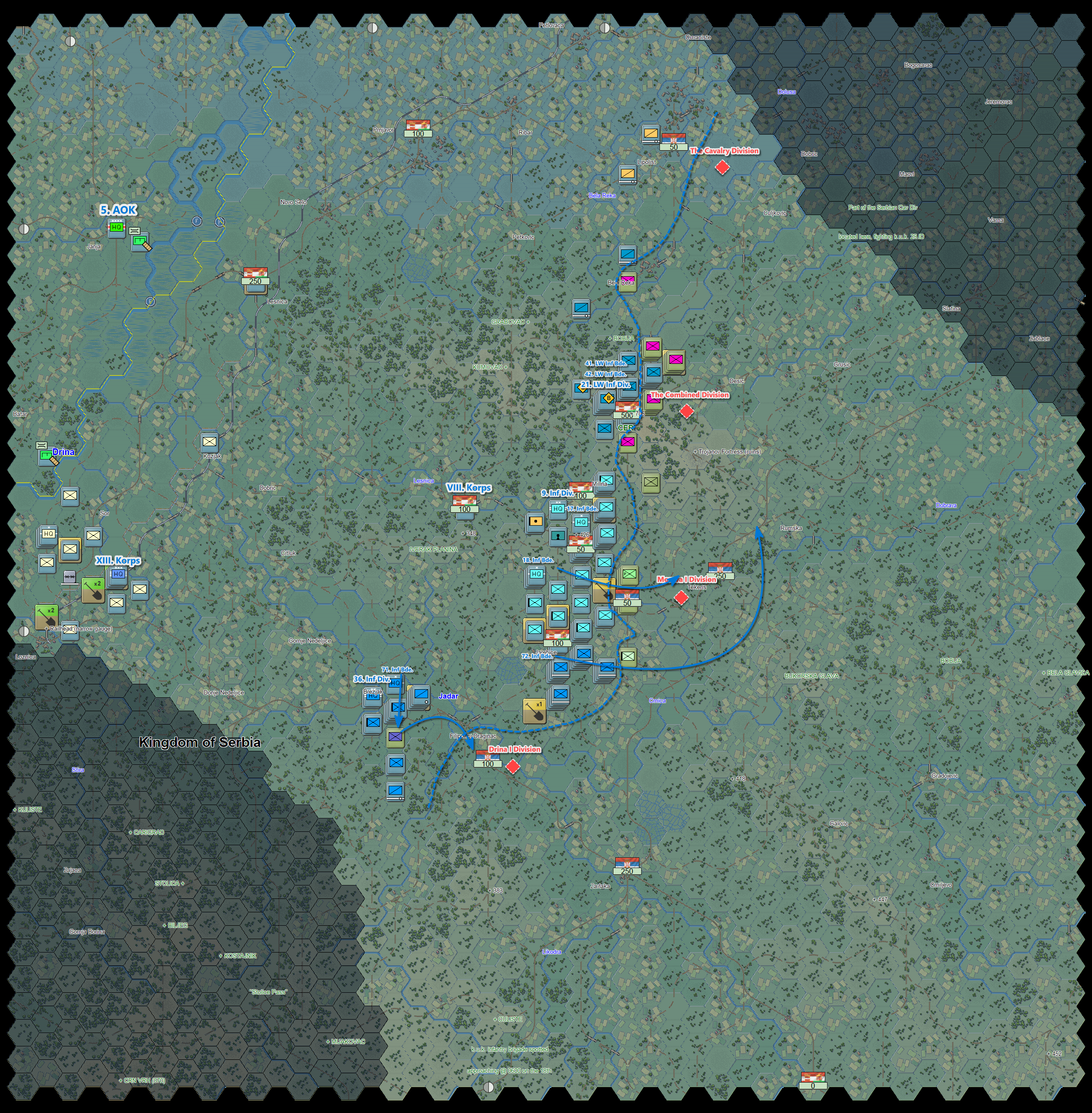
The entirety of 21. LW Inf Div. has continued to become heavily weakened and disrupted due to actions by the Combined Division to the point of devolving into a single ad-hoc formation. With Serbian units now under the cover of forest, defensive fire has reduced in effectiveness, made worse by an unsteady supply of ammunition. Divisional field guns continue to be relied on heavily, but in general the division is in a poor state. Withdrawing is not an option due to a high likelihood of a rout.
9. Inf Div. continues to hold the Milina-Pt. 426-Jarebice line strongly, weathering a number of attacks from Morava I Division, which has since withdrawn to recover. Due to open approaches to this line, defensive fire has been highly effective.
36. Inf Div. is still in the process of clearing around Brezjak before recommencing its advance on Filipovici-Draginac. 72. Inf Bde. has reached 9. Inf Div's area and is set to commence an advance against Tekeris in hopes of threatening the Serbian left flank and relieving pressure against 21. LW Inf Div.
11. Gb Bde. is scheduled to arrive early morning. Their threat to the Serbian southern flank will facilitate 36. Inf Div's advance on Filipovici-Draginac by causing the need for Serbian forces to cover 2 approaches.
In the far north, army-level reconnaissance units are currently on the outskirts of Lipolist, which appears to have been vacated by the Serbian Cavalry Division, and it has been some time since there has been a sighting of any Serbian cavalry units.
Actions of 18 August 1914
21. LW Inf Div. continued to come under heavy assault through the course of the day, against elements of the Combined Division who was by this point also breaking off to support Morava I Division's assault on the Milina-Pt. 426 line as well as skirting our northern positions and moving further west. At 1600, the Serbs finally broke through and got the better of the depleted division on the summit. The division withdraw northwest and continued to put fire on Serbian units at the summit.
9. Inf Div. continued to withstand assaults from Morava I Division and were able to isolate a number of battalions that had participated in failed assaults against the line. The majority of divisional heavy weapons remained in tact meaning the division is expected to continue to be able to hold through the night, but the division will likely need to shift part of its defenses to the north to guard against envelopments by the Combined Division, coming off their success at Mount Cer.
36. Inf Div. succeeded in capturing their stated objective of Filipovici-Draginac, even if at relatively slow pace due to disruption from ineffective command, with 71. Inf Bde. in the lead, supported by divisional and corps artillery. 72. Inf Bde. advanced far to the east, past the line held by 9. Inf Div. and were able to pressure the Morava I Division from the south, and threaten the holding at Tekeris.
11. Gb Bde. arrived early in the morning and started marching north to threaten the southern approach to Zavlaka, but did came under fire from Serbian field guns and howitzers early on, before reinforcements from the Drina I Division arrived, bringing the brigade to a halt. It appears the bulk of that division had abandoned Filipovici-Draginac and withdrew further east
The situation at 0000 19 August 1914
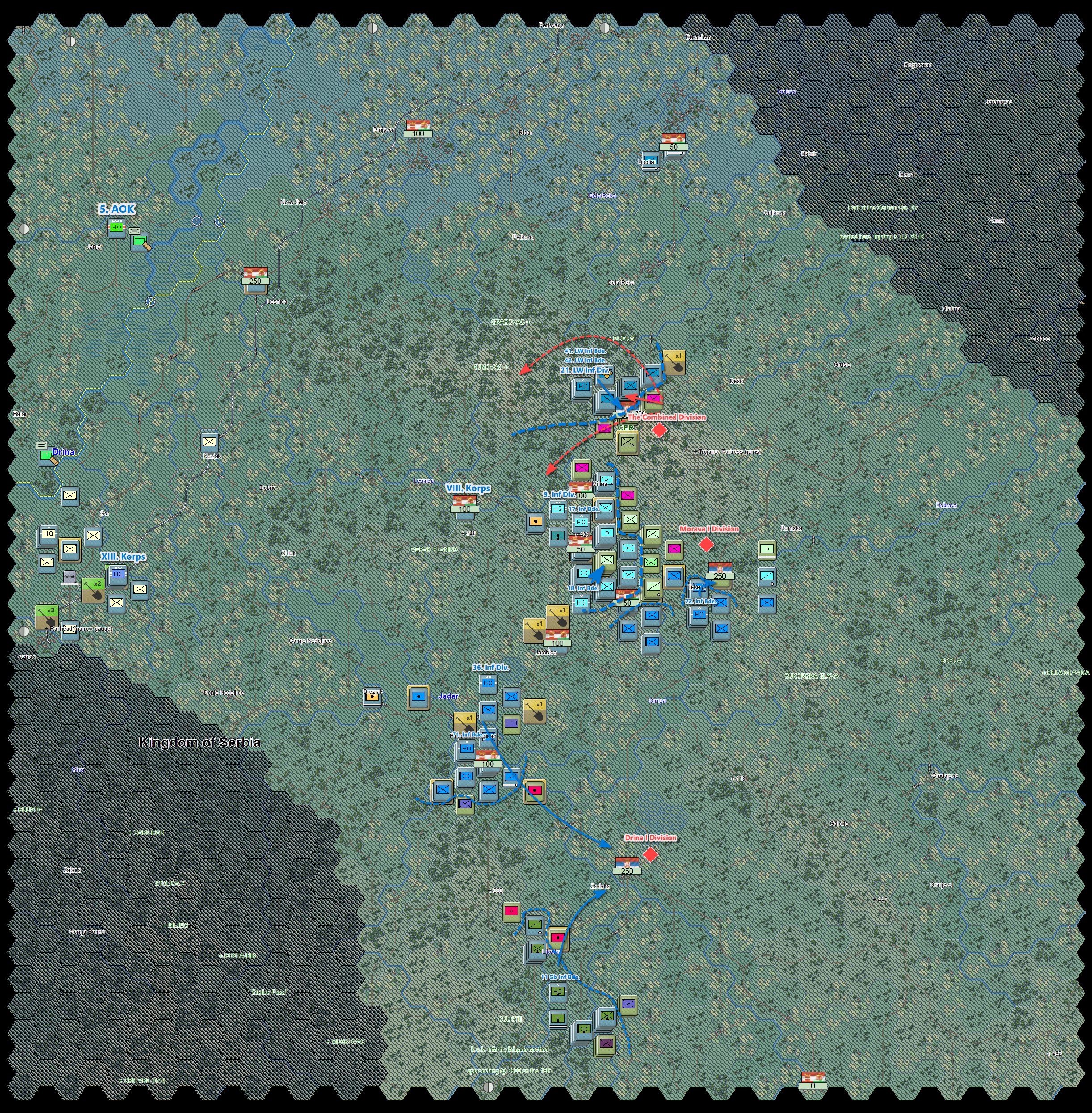
21. LW Inf Div. has been severely weakened under pressure from the Combined Division over the last 2 days to the point where it is no longer to be considered an effective fighting unit, with a number of battalions in full rout. They failed to hold their objective. For the purpose of this operation and the time constraints faced by both Austria-Hungary and Serbia, they have held on long enough and inflicted enough casualties to have served their purpose.
9. Inf Div. has held the Milina-Pt. 426 line strongly under heavy pressure, and have repelled each assault and taken numerous prisoners. Field guns and howitzers in support continue to be effective. It is likely that the enemy will start applying pressure from the direction of Mount Cer, but it is expected that the division will be able to hold for the time being.
36. Inf Div have successfully achieved their objective of capturing Filipovici-Draginac and has done so utilizing 71. Inf Bde. exclusively. The ability to have committed 72. Inf Bde. to 9. Inf Div's sector has been a success. 5. AOK was not expected to be in a position to threaten Tekeris at any point based on original plans, but due to 72. Inf Bde's success, has been able to do so. Given the fatigue and state of disruption, it is not expected that 72. Inf Bde. will actually be able to secure this objective, but the threat should cause a split in the enemies efforts in the area.
11. Gb Bde. was not expected to contribute significantly in the operation due to their late arrival. Their encounter with Serbian 3. Army units in the area does mean fewer units available to the enemy further north, and they have thus served a purpose, if only to threaten.
Actions of 19 August 1914
21. LW Inf Div. continued to be largely ineffective into the morning due to heavy casualties, low ammunition and command disruption. At 0800, a single battalion (II./LWIR. 6) managed to regain enough cohesion to effect an assault on Mount Cer summit, dislodging the Serbian defenders after the majority of the Combined Division at started to depart in order to join the offensive at Milina. This single battalion was able to hold the summit until the end of operations.
9. Inf Div's 17. Inf Bde. completed liquidation of isolated pockets of scattered attackers around Pt. 426, taking numerous prisoners. Morava I Division continue to mass for assault through the morning, but very selective fire and counter attacks by 18. Inf Bde. and artillery ensured the enemy was not in a state to attempt an actual breach.
36. Inf Div. ceased their advance advance to Zavlaka, having achieved their objectives and being deemed too disrupted to fight effectively given the impending timeline. 72. Inf Bde. did not manage to regain sufficient composure to attempt further assaults on Tekeris.
11. Gb Bde. were met with heavier concentrations of infantry from Drina I Division and were unable to advance any further through the course of the morning, consolidating their position and remaining in place.
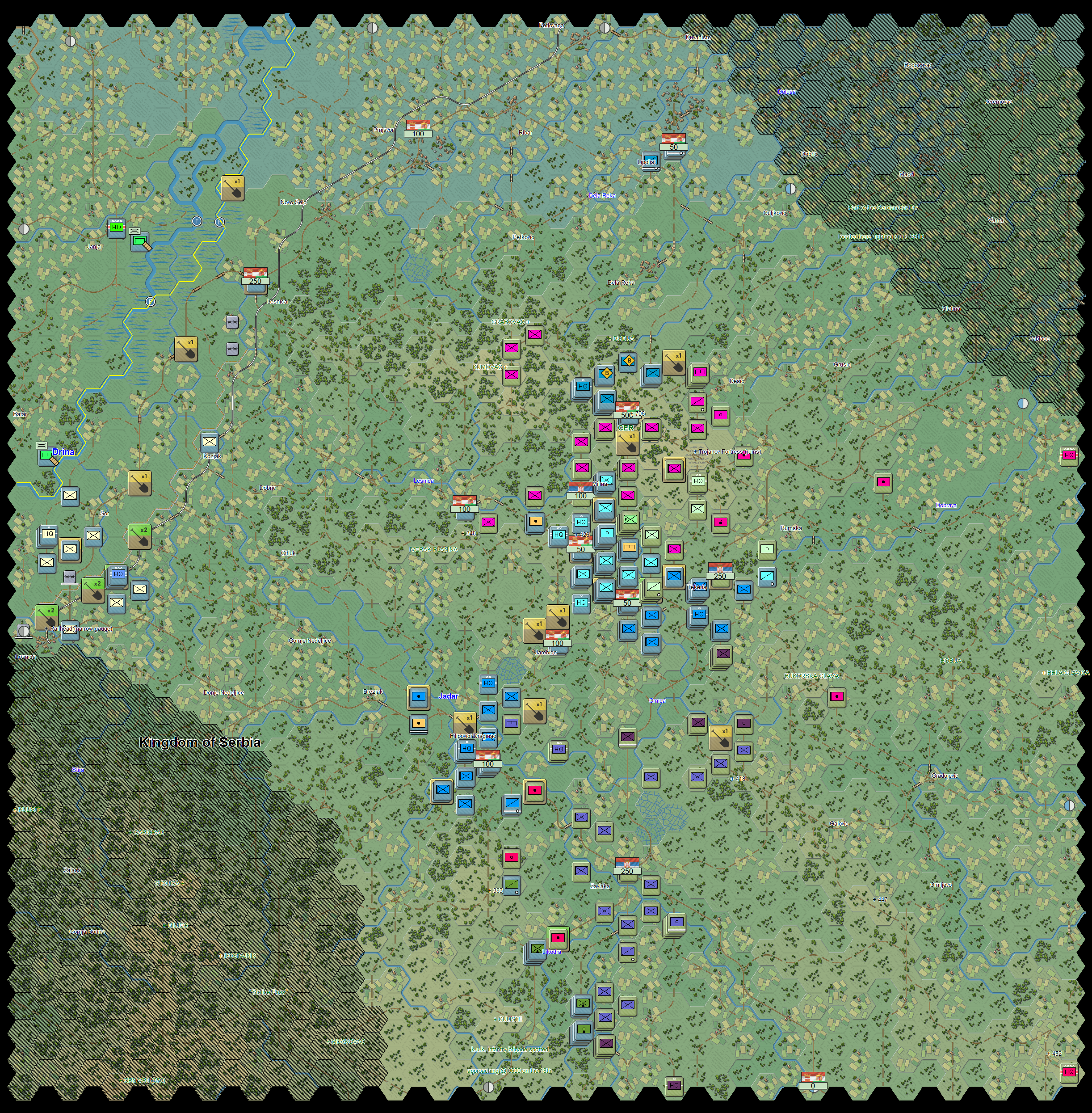
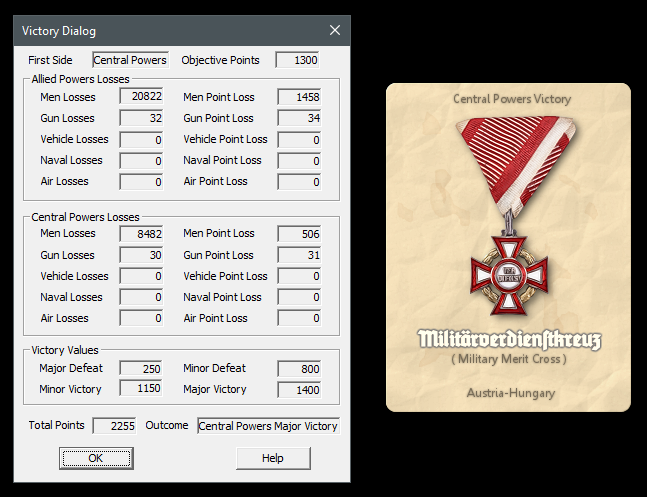
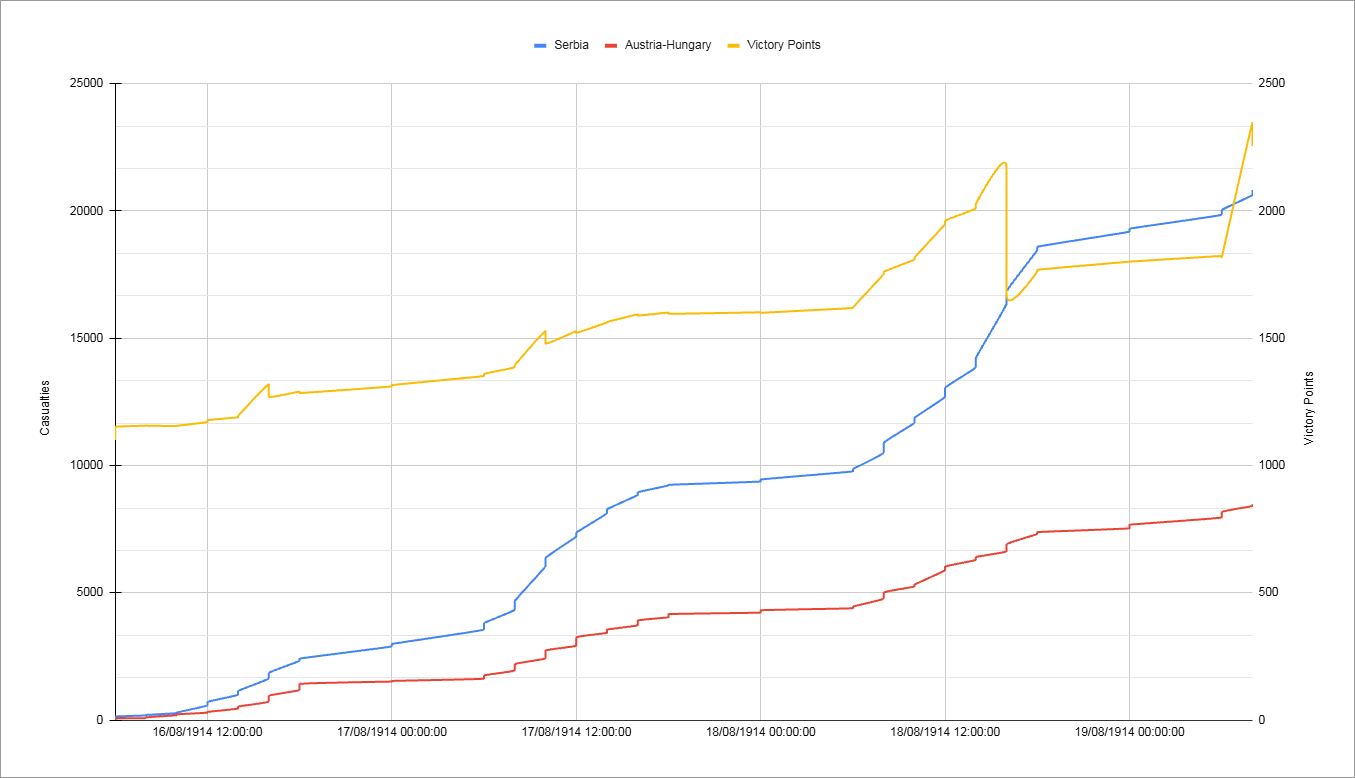
Operations ended at 1000, 19 August 1914 in a Central Powers Major Victory. Lipolist, Mount Cer, Milina, Pt. 426, Jarebice and Filipovici-Draginac were held by 5. AOK, but at the last minute, Serbian forces from the Combined Division heading south from Mount Cer captured Milina, displacing the divisional HQ there. Allied losses were at 20822 men and 32 guns, compared to 8482 men and 30 guns lost by the Central Powers.
Context
The Battle of Cer (16-19 August 1914) was the first major Allied victory of the First World War. Following the Austro-Hungarian declaration of war on Serbia on 28 July 1914, Field Marshal Oskar Potiorek launched the invasion on 12 August, crossing the Drina and Sava with 5. Army and elements of 2. and 6. Armies. The goal was a rapid punitive occupation. Šabac fell on 12 August. Serbian forces under Field Marshal Radomir Putnik, with Serbian 2. and 3. Armies were outnumbered but held the interior and knew the terrain.
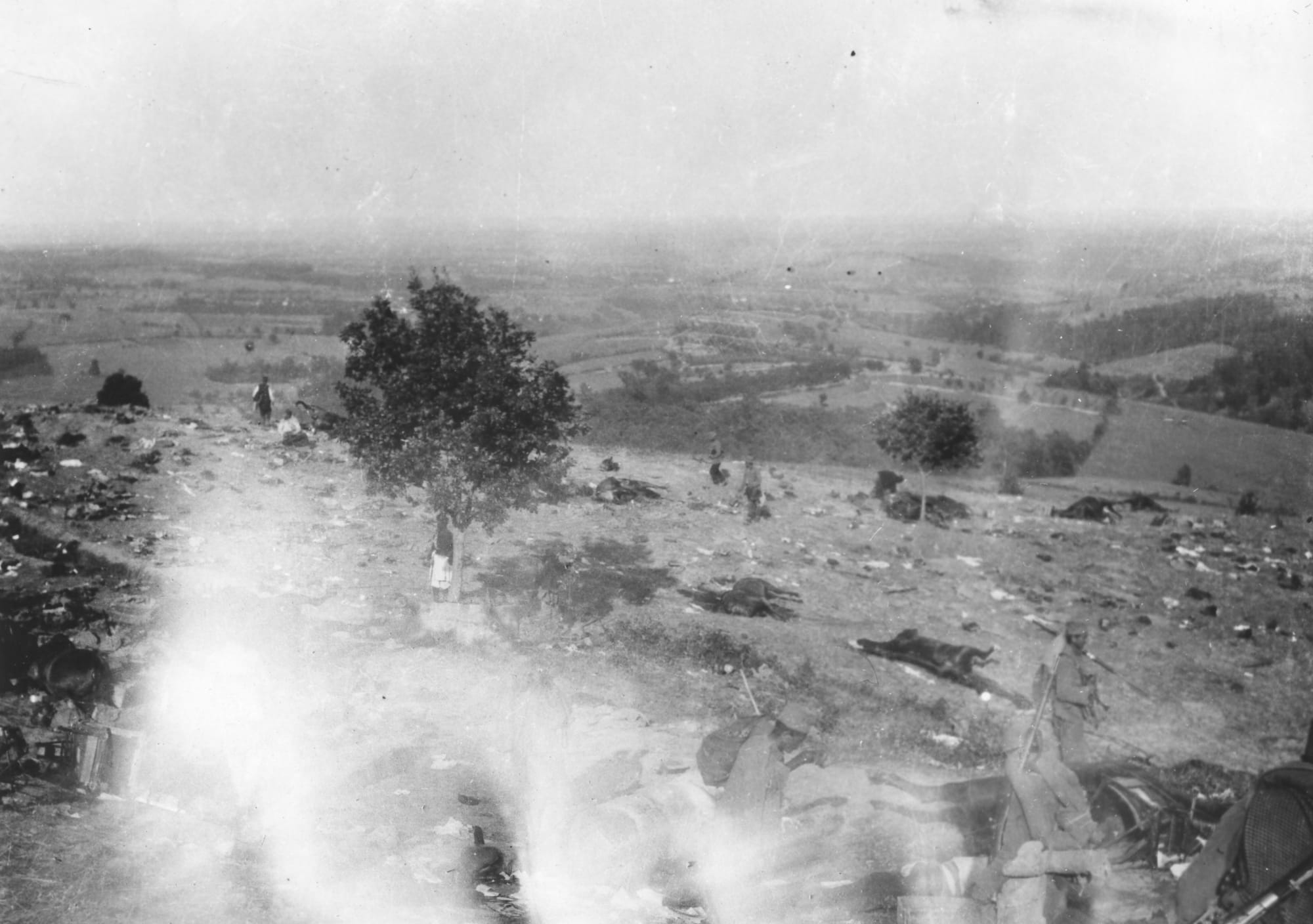
The battle started unexpectedly on the night of 15 August. The Serbian Combined Division, exhausted after forced marches of up to 50km, blundered into the hastily bivouacked Austro-Hungarian troops of the 21. Landwehr Division on the slopes near Tekeris. In darkness, the Serbs attacked the sleeping camps. Fighting was close and the Austro-Hungarians were thrown back, creating a gap between 2. and 5. Armies.
On 16 August, the Serbs continued pressure while the 9. Infantry Division counter-attacked and drove the Combined Division back temporarily. Fighting centered on the Cer-Iverak ridge, Kosanin Grad (Mount Cer's highest peak) and the approaches to the Jadar valley.
By 18 August, Potiorek realised that the hoped-for battle near Valjevo was not developing and that Cer itself was critical. The Combined and Morava I Divisions kept pressing west along the ridge. Austro-Hungarian artillery struggled to respond effectively in the broken terrain, and coordination between units suffered.
Shortly before dawn on 19 August, the Combined Division attacked again and overran Kosanin Grad around 0400, threatening the Austro-Hungarian 9th Infantry Division with encirclement. The Morava I Division drove the 9th off their positions and withstood a counter-attack. Austro-Hungarian morale broke and thousands of soldiers streamed back toward the Drina, where many drowned during their panicked retreat.
The main fighting around Cer ended on 19 August. Mopping up and the recovery of Šabac continued until 24 August, when Serb forces re-entered the town. Austro-Hungarian losses were around 6,000-10,000 killed and ~30,000 wounded. Serbian losses were 3,000-5,000 killed and ~15,000 wounded. The victory was the first clear Allied success of the war and forced Potiorek to withdraw across the Drina, ending the first invasion of Serbia.
Commentary
I tend to only read about these lesser-known battles after I actually finish playing them and I found it interesting how closely troop movements in this scenario matched reality, but with a different outcome. It wouldn't have been a huge stretch for us to have reached a similar result as I feel we were certainly saved by the clock in this instance.
As a relative WDS newcomer, this is my first battle commanding low-quality troops like the Austro-Hungarians. They are brittle. The battle became one of pure attrition. High fatigue and low morale meant that even relatively fresh Austro-Hungarian units lost cohesion almost immediately following contact, after which it was very difficult to restore. This makes combat a matter of disrupted battalions standing next to each other, trading shots and seeing who breaks first. I found that it isn't something you can offset with maneuver either, given their low movement rates and the difficult terrain. I imagine these types of battles on the Western and Eastern Fronts would have a very different feel.
I noticed that the Serbians fared quite a bit better in rallying disrupted troops to the point where it seemed like a massive advantage. I realise that my HQ placements were not very optimal and this will be something I look at much more closely in future battles. Even if the actual advantages gained from having an HQ a bit closer to a front-line unit are marginal, over the course of dozens of turns and dozens of units, these small gains are sure to add up. In future operations I will continue to experiment with unit placement, I suspect that a more layered defensive line with reserves, and rotating your battalions in and out of the front-line might be beneficial when it comes to speeding up their cohesion recovery, not to mention preserving their precious fatigue. The state in which this operation started, the area that needed to be covered and the numbers we had available simply did not allow for it in this instance.
The supply situation did not help either. My units were sitting on average around 23% supply rate, which is terrible. I do not expect this will get better in the subsequent invasions of Serbia either, so we have that to look forward to.
The Serbian Cavalry Division, after they did such a nice job of threatening my far northern flank ended up withdrawing from the field altogether. This seems to be justified in scenario-terms as being due to having to engage the Austro-Hungarian 29. Infantry Division.
The AI did not seem too bad in this particular battle. They kept going for massed frontal assaults, which certainly made sense given their qualitative and organisational superiority against my heavily attrited lines, it does seem a bit lucky that nothing major got through. I found the Combined Division's pivot south in the latter phases a bit odd given the number of 21. LW Inf Div. units still present, but in pure strategic terms it made sense to support Morava I Division in attacks against 9. Inf Div, so I don't actually mind this, and as I mentioned before, the AI does not really seem to factor in the scenario end times, so I very much think that we were saved by the clock here. Had this gone on for another 3 days I expect our lines would have eventually broken.
Overall I found this enjoyable, if a bit grindy. Regardless I'm looking forward to more adventures into the Balkans and refining my play.
Next up, we'll be in East Prussia in the prelude to the Battle of Gumbinnen, where German general Hermann von François disobeyed orders and engaged Imperial Russia at the Battle of Stallupönen.