France '14: The Battle of the Silver Helmets

Background
Haelen, Belgium, 30km northeast of Louvain, 12th August 1914:
Following the isolation of Liège, the German H.K.K.2 advanced northwest. The Belgian began forming a defensive position along the Gete and the Division de Cavalerie held the northern flank of this line. It was here that the first cavalry clash of the war occurred, in which the Belgian General de Witte ordered his cavalry to dismount and hold the bridges along the main roads through Diest and Haelen.
In what would later become known in Belgian folklore as "The Battle of the Silver Helmets", the Germans waged a bloody day long battle in which they launched charge after charge at the defenders, with each being repulsed in turn. The Belgians would contain von Marwitz's cavalry advance and thus cause him to wait for German infantry support before again attempting a crossing of the Gete.
Brief
0600, 12 August 1914
Mission
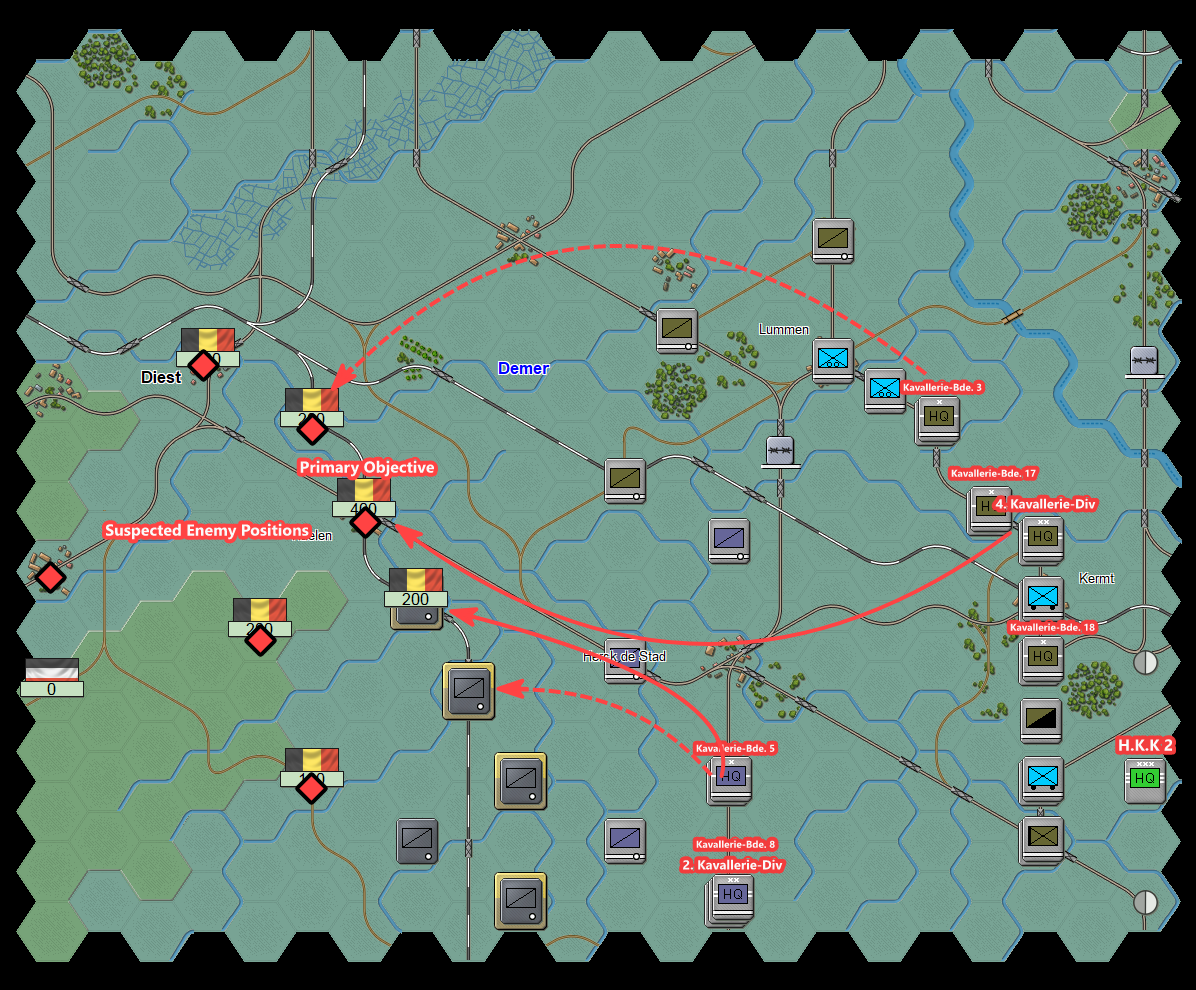
H.K.K 2 is to seize stream crossings in the vicinity of Haelen, primarily the heavy bridge in that area, while also securing defensive positions to the North and South of Haelen. This is in order to facilitate maneuvre of 1. Armee westwards into Belgium and France. End state: crossings controlled or denied to the enemy by 1800, with the corps still able to screen or reconnoitre further west.
Enemy
Enemy forces are estimated to be a division-sized dismounted cavalry formation, along with the relevant support teams such as engineers, field guns and machine gun crews. These forces are expected to be entrenched along the streams in this area and are supplied via roads west and south-west of Diest. Enemy forces are likely to defend the bridges and approaches rather than counter-attack in strength. The heavy bridge at Haelen is assessed as wired for demolition, enemy engineers are expected to attempt to destroy it if German forces approach closely.
Terrain and Weather
Terrain is mainly flat and open at low elevation, with scattered woods, orchards and villages. A primary road goes east to west from Kermt, through Herck de Stad, Haelen and Diest.
Open ground east of Haelen gives good observation and long fields of fire for Belgian guns and rifles in and around Haelen. German units massing or moving in the open are exposed.
A secondary road running north to south to the east of the Gete will facilitate rapid movement of troops positioning for attack.
Weather is currently Normal, with 4km visibility. Predictions for the next 24 hours is 100% chance of Normal conditions, with visibility ranging between 4km and 5km. Sunrise is at 0600 and sunset at 1800
Troops Available
Friendly forces are as follows:
H.K.K 2 (von Marwitz)
—3. Kavallerie-Div
——Kav. Bde. 5
———I./Dragoner Regt. 2
———I, II and IV/Ulanen-Regt. 3
——Kav. Bde. 8
———I./Kurassier-Regt. 7 - scheduled to arrive after 0800
———I./Husaren-Regt. 12
—— Leib-Garde-Husaren-Bde - scheduled to arrive after 1200
———I./LHR. 1
———I./LHR. 2
—4. Kavallerie-Div
——Kav. Bde. 3
———I./Kurassier-Regt. 2
———I, II and III/Ulanen-Regt. 9 - to be withdrawn at 0800
——Kav. Bde. 17
———I./Dragoner-Regt. 17
———I./Dragoner-Regt. 18
——Kav. Bde. 18
———III./Husaren-Regt. 15
———I./Husaren-Regt. 16
—Supporting units (H.K.K. 2)
——Reiter-Abt./FAR. 3 (12 guns)
——MG-Abt. 2
——Jäger-Btl. 3
——Jäger-Btl. 4
Time
Time available is limited, seizure of Haelen and surrounding objectives is expected to be achieved by 1800, 12 August.
Civilian Considerations
Civilian presence is expected to be negligible
Execution/Tasks
Kav. Bdes 5 and 8 are to conduct pinning attacks on objectives south of Haelen, and if able, break through in order to support the main attack on Haelen.
Kav. Bde. 3, supported by reconnaissance units of Jäger-Btls 3 and 4, are to conduct a pinning attack on objectives north of Haelen.
Kav. Bdes 17 and 18, supported by infantry from Jäger-Btls 3 and 4, and supporting fire from Reiter-Abt./FAR. 3 and MG-Abt. 2 is to position, and then conduct the main assault on Haelen, as soon as possible, with targeting preference given to hostile support weapons such as field guns and machine guns
The strict time limit will required an all-out attack and as such, no reserves will be held.
Battle
The first four hours were spent mostly in maneuvre. An early probe south of Haelenby Husaren-Regiment 12 and Dragoner-Regiment 2 was thrown back by Belgian cavalry. Everywhere German units moved, they drew fire from the Belgian guns sitting in and around Haelen. The approaches were already under observation.
Around 1200, second southern attack succeeded. Belgian units were driven off at a cost of 71 German casualties; the defenders lost 237 men and the Central Powers picked up a key location for 200 victory points. At the same moment the advance of Jäger-Bataillon 3 toward Haelen triggered the demolition of the bridge running southeast out of the town. Reiter-Abt./FAR. 3 managed to get guns into position northeast of Haelen, opening the possibility of counter-battery work, but the Belgian artillery continued to punish the Hussars and Dragoons massing southeast of the town for the main assault.
Two more hours was spent under that fire. 4. Kavallerie-Div. continued to form up and tried to rally the squadrons that had already been shaken. The Belgian guns in Haelen kept the pressure on the open ground.
At 1400,the Jägers led an assault on Haelen itself. It was repulsed, though the Belgian line was visibly weakened. At the same time 2. Kavallerie-Div. worked its way immediately south of the town, positioning itself to join the final push.
At 1600, the last movements for the day brought the massed assault: Jägers, Dragoons and Hussars of 4. Kavallerie-Div. going in together. The Belgian infantry in the town fell back, and the position was heavily disrupted, but the cavalry and the guns stayed. Haelen was still held when the clock ran out.
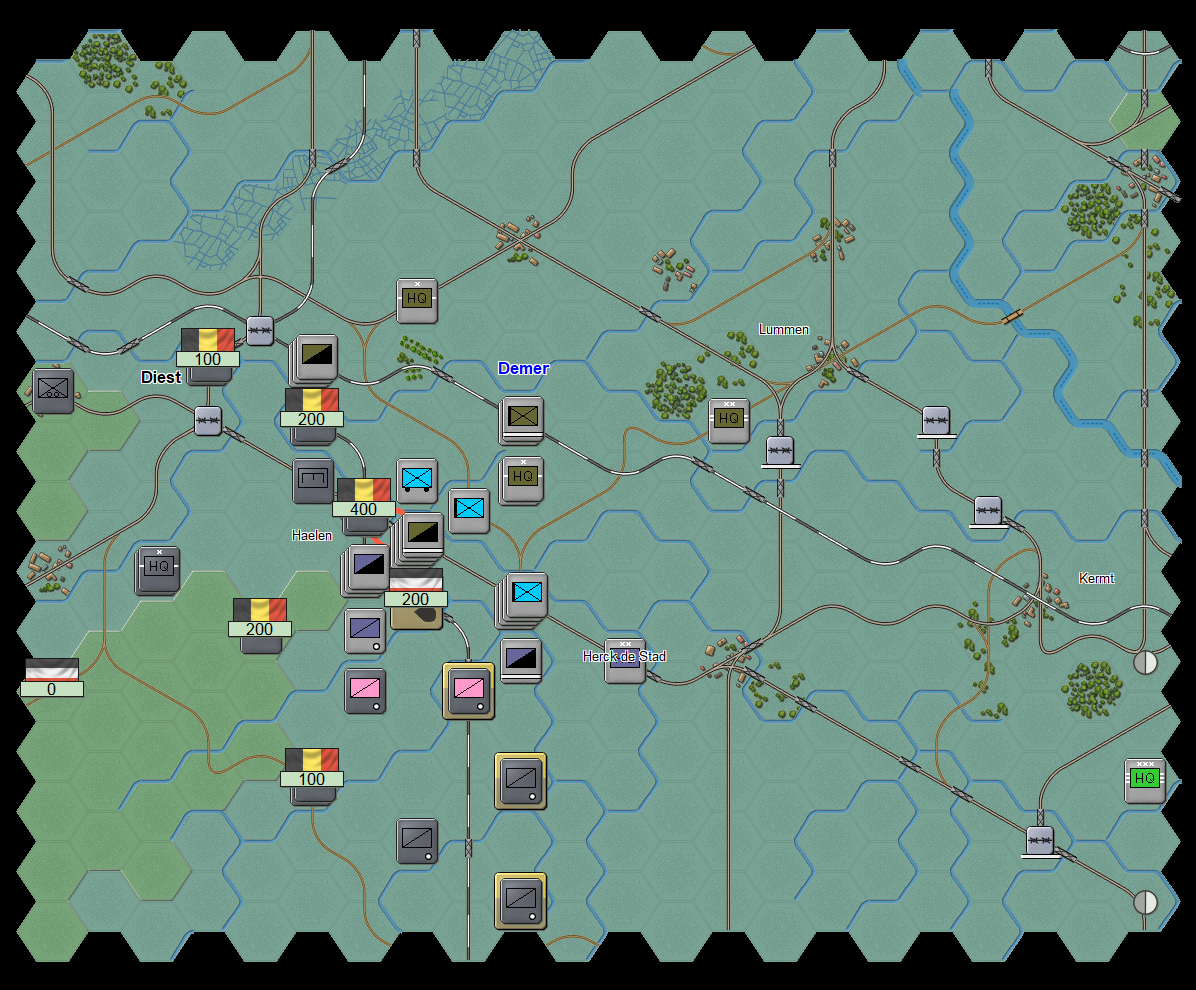
The guns in Haelen had been consistently deadly against cavalry in the open. The southern brigades, having failed to rally cleanly after their earlier fights, were less able to support the main attack than planned. Better placement of the supporting artillery earlier might have given more suppression of the Belgian defence before the final charges went in.
In the end the crossings were not forced. The Belgian cavalry and artillery remained in place, exactly the result de Witte had sought by fighting dismounted rather than meeting the German squadrons on horseback. The limited German force had made local progress and inflicted losses, but the short window closed with the Gete still denied.
The final result was 970 casualties and 9 guns lost for the Allied Powers, and 1785 casualties for the Central Powers, with only a single key position seized by the Germans and the remainder still in Belgian hands, giving a result of a Central Powers Minor Defeat.
Context
The battle was a clear Belgian tactical victory. Léon de Witte’s dismounted Cavalry Division, supported by cyclists and limited infantry, held the Gete crossings around Halen against repeated German mounted charges. By evening the Germans under von der Marwitz broke off the attack and withdrew a short distance. They had failed to force the line that day and had to wait for infantry support before trying again.

The Germans had not been able to penetrate beyond the Belgian front or reconnoitre deeper dispositions. The action delayed the cavalry advance only briefly and had little effect on the overall German invasion of Belgium. Belgian forces later withdrew toward the fortified position at Antwerp as the Germans continued their advance, eventually taking Liège, Namur, and most of the country.
The battle is widely regarded as one of the last large-scale cavalry charges of its type on the Western Front. It demonstrated that traditional shock tactics were obsolete against modern rifle and machine-gun fire. German officers later described units as effectively destroyed after riding into fire, wire, and sunken roads. Heinz Guderian later used the action in Achtung Panzer! as an example of the limits of cavalry in the face of modern weapons.
Commentary
The short duration of this scenario called for a very simple plan: a massed charge against the enemy strongpoint, which due to lack of proper support proved to be ultimately unsuccessful.
Once our initial assaults were repulsed, there was little hope of succeeding later, but the tight constraints meant we had to keep trying. In the future, in the event of similar situations I'd look at better employment and positioning of heavy weapons such as machine-guns and field guns, as their effect was limited in this instance and they were only able to conduct effective fire for a small handful of turns.
The other takeaway is that in time-critical operations, it would be worth taking the time to mass forces for a single decisive assault as opposed to feeding them into battle piecemeal.
Our estimates of enemy strengths and positions also seemed fairly accurate, something we'll continue to assess in upcoming operations.